


On the Beauty of the Ruin
0:00
0:00
Welcome to the art of the watercolour by Abraham-Louis-Rodolphe Ducros, the fascinating world of the 18th century – and to the Campagna Romana, the hilly countryside around Rome.
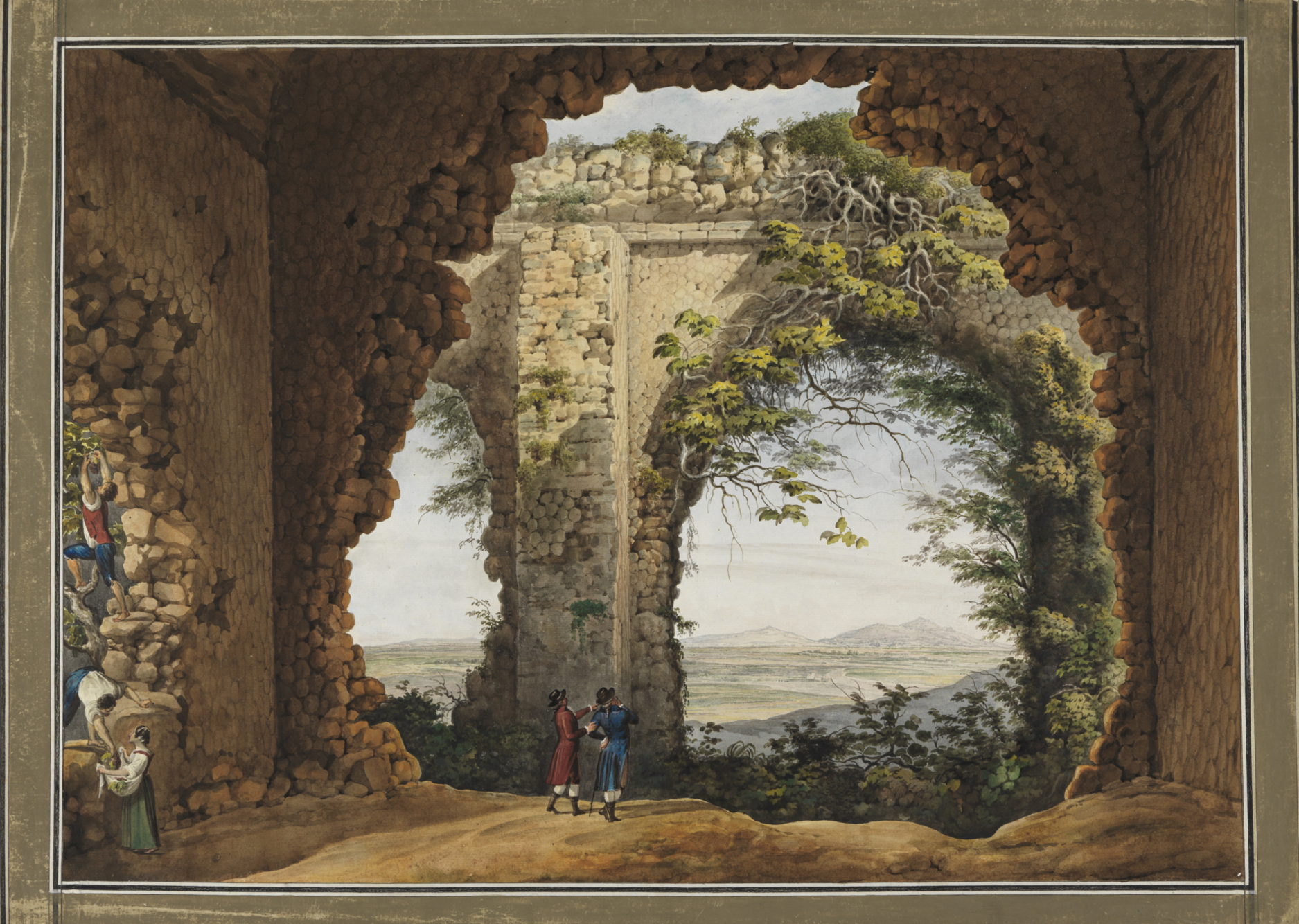
What is the first thing you notice here? The view of the spreading Italian landscape through the arches of this ruined building? Or the two men in red and blue frock coats gazing out at our shared vista? Or perhaps the locals on the far left harvesting the grapes?
The entire scene, bathed in a warm light, is structured by the building composed of terracotta-coloured stones. The wall’s contours dissolve, the edges rather like torn paper forming a kind of interface between the past and present. The warm stones are covered by dried branches and foliage.
Architecture as a frame for nature
As nature reconquers a monumental edifice constructed with such effort centuries before, we have an impression of the flora in this part of Italy. For a long time, this was thought to be the remains of the Villa of Maecenas. In fact, though, it was the site of the Sanctuary of Hercules the Victor, a massive complex from the Hellenist period.
Ducros uses the ruins to frame an Arcadian landscape. At the centre, two figures of cultural travellers are enjoying the enchanting expanse of the Campagna. Famous for its picturesque beauty, this large pastoral area surrounding Rome inspired many artists – including Giovanni Battista Piranesi, whose work proved a seminal influence on art, architecture and literature.
Following this tradition, Ducros not only emphasised the sublimity of nature, but also highlighted the heroic aspects of classical architecture.
Capturing the status quo
Born in Moudon, Switzerland in 1748, Ducros accompanied the etcher Isaac-Jacob La Croix to Italy in 1776. Settling in Rome, he worked there for a long time as an artist and art dealer. Although his work primarily explored Roman antiquity, he focused more on the monumental nature of the buildings than on rendering them with scientific accuracy.
Today, works like this, produced in great numbers for the art market as souvenirs, offer an insight into the building culture of previous eras. Not only are Ducros’s paintings artistically valuable, they also testify to the spirit of the 18th century, a time when impressive works like this captured the fascination with the classical world, archaeology and topography.