


The Return of the Poet
0:00
0:00
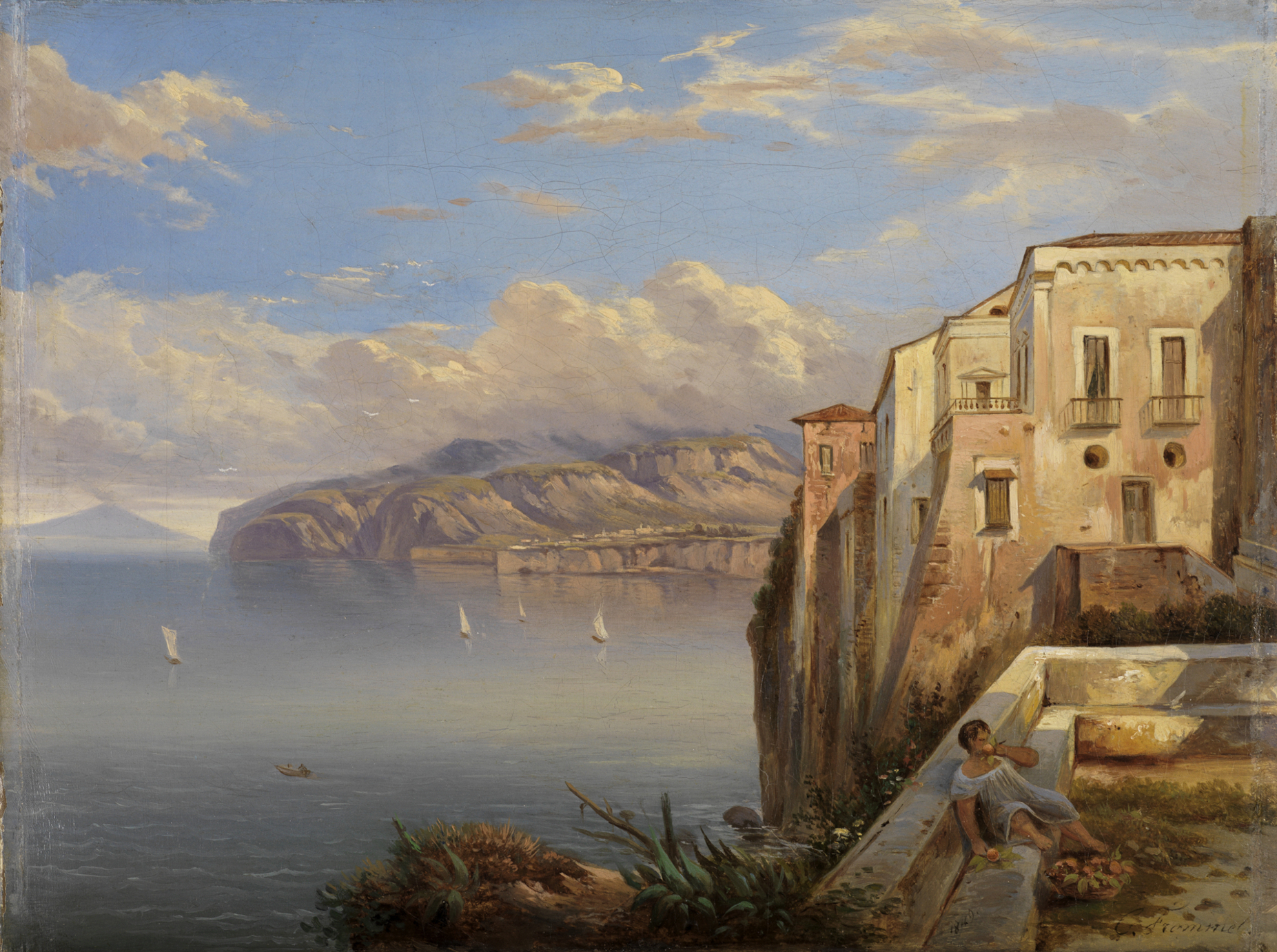
The scene in this small format landscape by Karlsruhe artist Carl Ludwig Frommel seems nothing short of idyllic. Bathed in the ochre-tinged midday light, the typical Italian houses to the right seem to merge with the rocky cliffs they stand on.
The man in the foreground, dressed in a simple robe and eating oranges, has settled comfortably in the shade. But unlike us, he shows no interest whatsoever in the magnificent view of the bay with its sailing boats.
Drifting along the mountain slope towards the town, the bank of heavy clouds look as if they will bring rain at any moment. Vesuvius is visible on the far left, a plume of smoke rising from the volcano’s crater.
The myth surrounding the famous poet
This might seem just a typical Italian landscape, but the title – The House of Tasso in Sorrent – indicates it is something more. Torquato Tasso was a 16th-century Italian poet primarily living and working in Ferrara as the court poet.
He may well have suffered from mental issues throughout his life leading to, among other things, persecution anxiety and other delusions. Tasso inspired the famous German writer Johann Wolfgang von Goethe to an eponymous play dramatising the poet’s struggle. In Goethe’s play, Tasso manages to escape from his position as court poet and become a free creative artist, yet ends up alone and unhappy.
This has many parallels with Goethe’s own situation at the court in Weimar, and his desire to resign from his position as a court official to become an independent writer. In the wake of Goethe’s play, the house where Tasso was born in Sorrento became a place of pilgrimage for many Romantic artists and travellers to Italy.
The artist Carl Ludwig Frommel also studied in Italy from 1812 to 1817, before returning to Karlsruhe where he became a court artist and professor at the Academy of Fine Arts. As director of the Grand Ducal Gallery, he opened its new building in 1846. In this painting, Frommel may even have portrayed Tasso himself; according to legend, when Tasso was wanted as a rebel he returned to his birthplace dressed as a farmer.
Torquato Tasso still lives on today, above all thanks to Goethe’s play, as one of the greatest Renaissance poets, admired for poetic as well as magical qualities. In the play, Goethe writes of Torquato:
«He ennobles what we despised, shows what we cherished worthless! / He’s a magician, luring us to walk in magic circles of his own devising, and share his course »