


A visit to Murnau at Lake Staffelsee
0:00
0:00
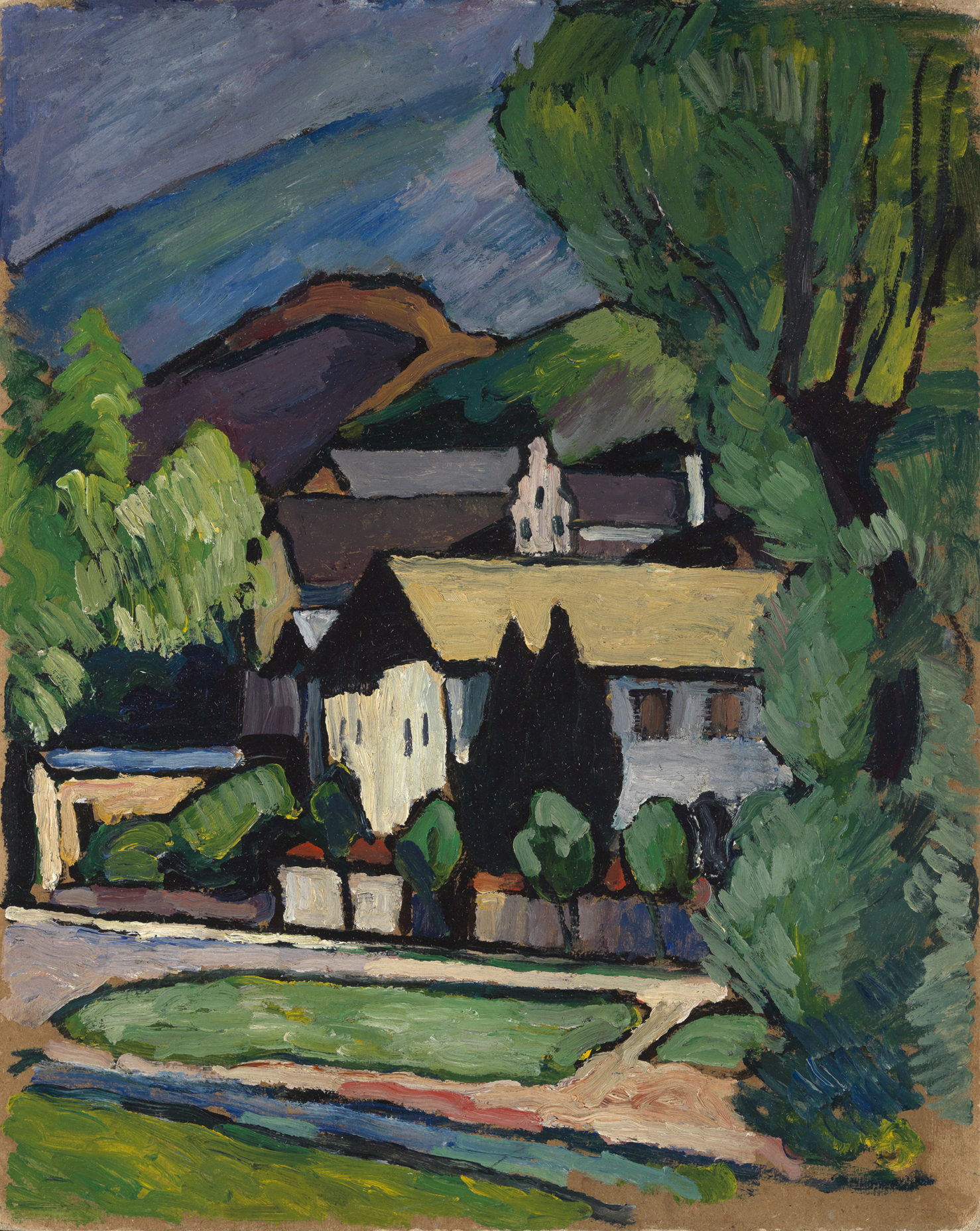
Summer. A peaceful and idyllic village green in the midday heat. Around about, the imposing village houses and the sweeping lush green branches of the trees. In the background, a panoramic view of the mountains. The bright house façades reflect the glaring light. The sky is rendered in a blue tinged with purple – possibly heralding an impending thunderstorm.
With all the people in the village now indoors, it’s the perfect moment for the artist to work undisturbed, exploring the relationship between the natural world and dwellings made by human hands.
Have you noticed how the artist arranges his subject to create a sense of depth? He has not only staggered the house roofs, but also the mountain peaks, steadily rising behind them. In equal measure, this composition addresses what is made by humankind and the natural world.
In rich, brilliant colour surfaces, the landscape and buildings seem to naturally complement one another – evocative and harmonious.
The artist, Alexander Kanoldt, successfully creates this effect through a certain degree of abstraction and by seemingly avoiding details. The elements structuring the composition, the vegetation, walls, roofs and rocks, are all rendered in areas of sheer colour bordered by powerful dark contour lines.
We can clearly see the energetic brushstrokes, set closely together, lending the individual areas their structure and an almost sculptural quality. In this picture, the artist captures the dynamic process of his work.
Initially, Alexander Kanoldt studied classical landscape painting in Karlsruhe. Around 1909, though, he became fascinated by the expressive and colourful works of the French avant-garde artists. Soon afterwards, he joined Wassily Kandinsky, Gabriele Münter, Alexej von Jawlensky and Marianne von Werefkin to form the ‘New Artists Association of Munich‘.
This picture by Kanoldt was evidently painted in the Bavarian village of Murnau, the group’s favoured place to work. In terms of style and choice of subject, it has similarities with other Murnau paintings by members of the group. Yet Kanoldt also creates his own focus in the balance between architectural elements and areas of organic nature, an aspect which was to remain intensely important in his oeuvre.