


Futuristic Architecture Meets Untouched Nature
0:00
0:00
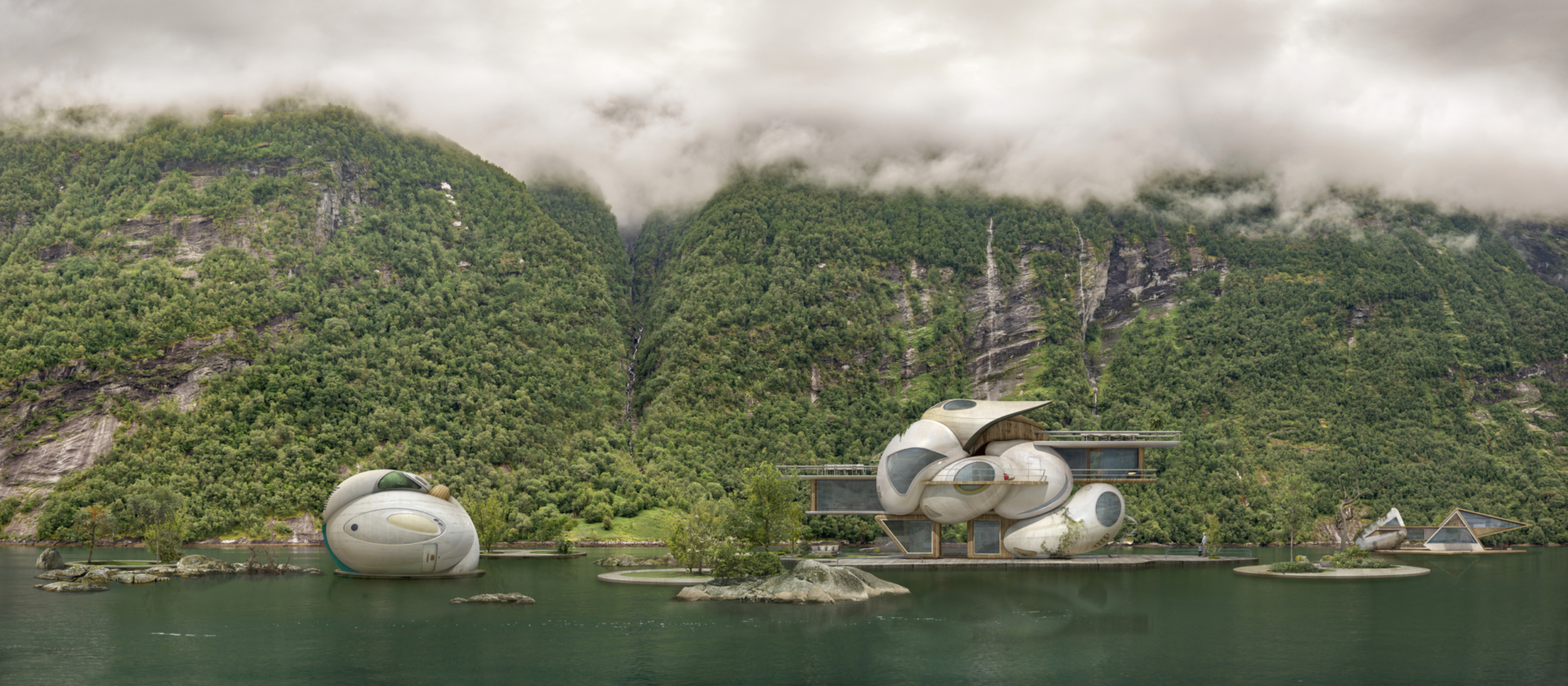
Could this be a spaceship? A submarine? Fish spawn? Or a vast cluster of cells? The egg-shaped structures nestle gently against each other, organically, rather like stones rounded and polished by the action of water.
They are set on artificial islands, smoothly dovetailed into the underwater shelf and harmonising perfectly with their rocky and forested surroundings.
Wittgenstein’s quiet retreat for contemplation
For his Wittgenstein’s Cabin series, Dionisio González inserted his computer-simulated architectural designs into photographs. The series is named after the philosopher Ludwig Wittgenstein, who died in 1951. To work on his philosophical ideas undisturbed, Wittgenstein liked to stay in very isolated places.
He found just such a quiet and beautiful site in Norway and, in 1914, had a small hut built there. Set on a high cliff in a remote spot, it was very difficult to reach. From the hut, he could look down Sogn Fjord, Europe’s longest and deepest fjord, which you can see in this work.
Solitude as a source of inspiration
Inspired by Wittgenstein, González explores the question of how the philosopher’s building might look today or in the future, and the potential inherent in isolation.
The hut has travelled down the green forested cliff to the edge of the water. The dense layer of cloud and the steep mountainous slopes stretch across the entire breadth of the picture, emphasising the impression of isolation without evoking a sense of unease.
Wittgenstein‘s Cabin seems to chime with the natural world around it, a modern, robust refuge for hermits.