


Reduced to the max.
0:00
0:00
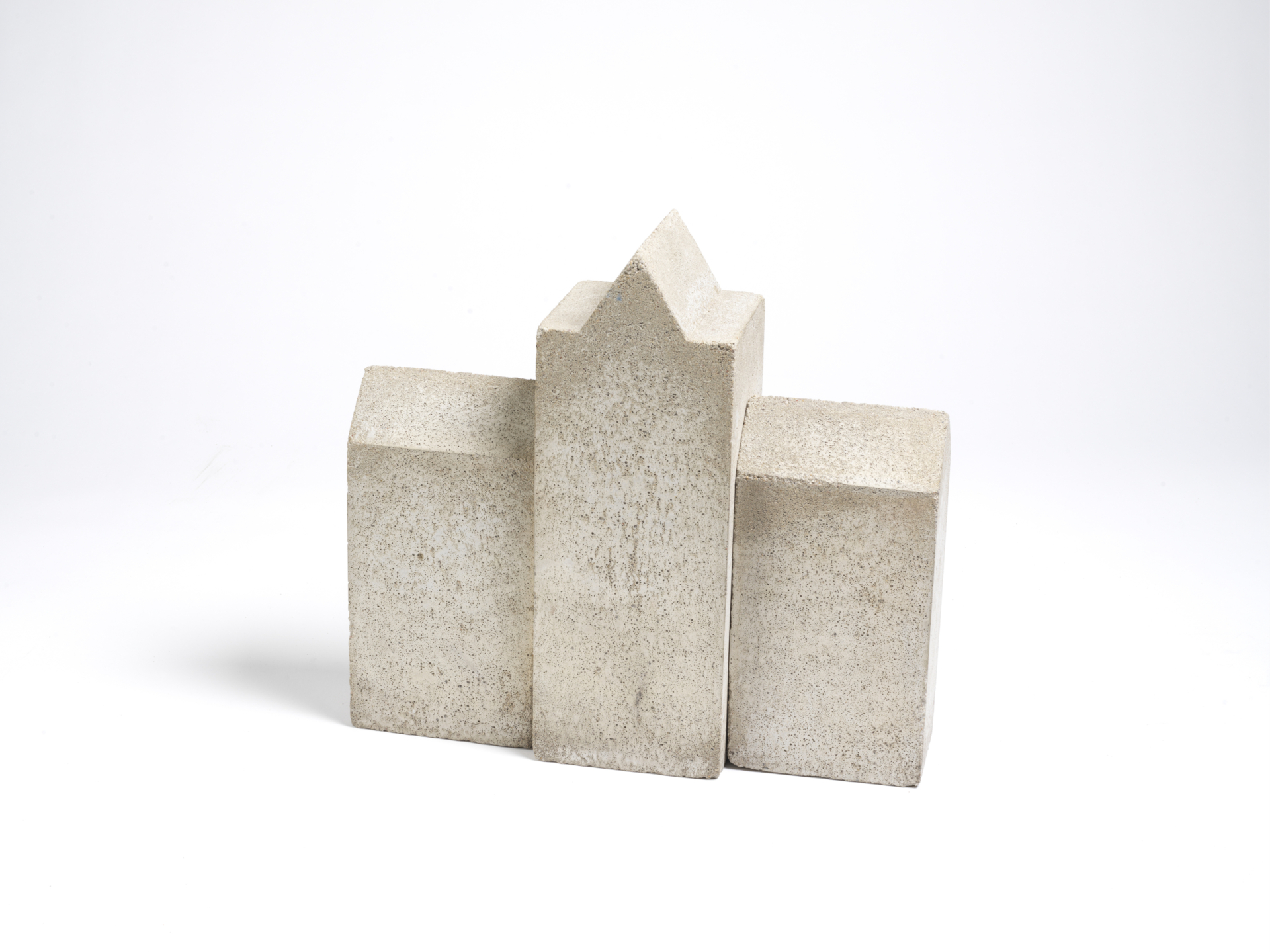
What could this be? It’s so small and cute, you’d almost like to touch or play with it – but that’s not what it’s for. This concrete sculpture by the artist Hubert Kiecol is called Old School without a Yard.
The austere work forms a closed shape. It comprises three parts in a symmetrical mirror structure. The two outer elements have a flat top, while the higher tower in the centre has a gabled roof.
Pure concrete
The work evokes ambivalent feelings in viewers. With its reduced form, hard material and grey colour, it seems cold, rough and forbidding, yet given the size of the object, it seems harmless and amenable, rather like a miniature, a model or a toy.
In this way, the artist plays with us and our perceptions. Hubert Kiecol places some of his works directly on the floor, without a plinth; others are set on high concrete stele. Their positions influence the way we perceive the objects spatially.
Kiecol is renowned for his architectural sculptures in concrete, a material which, since the 20th century, has played a key role in architecture. At the same time, concrete has a high carbon footprint, since its production accounts for around 8% of global carbon emissions. Kiecol creates massive, compact, windowless works in unadorned concrete which resist any idea of entering them, let alone living in them.
No building designed for dialogue
This sculpture thus deliberately denies one function we normally connect with architecture – the provision of a roof over our heads.
The title itself is ambiguous. Is this an old school with a shortage of space? Is the yard around it missing – a place for casual social interaction, communication and breaks between lessons? Or has the school lost the site it should stand on?
Undoubtedly, in our minds we can play with the object and the meaning of its title – a space for associations and emotions.