


Technology in the Countryside
0:00
0:00
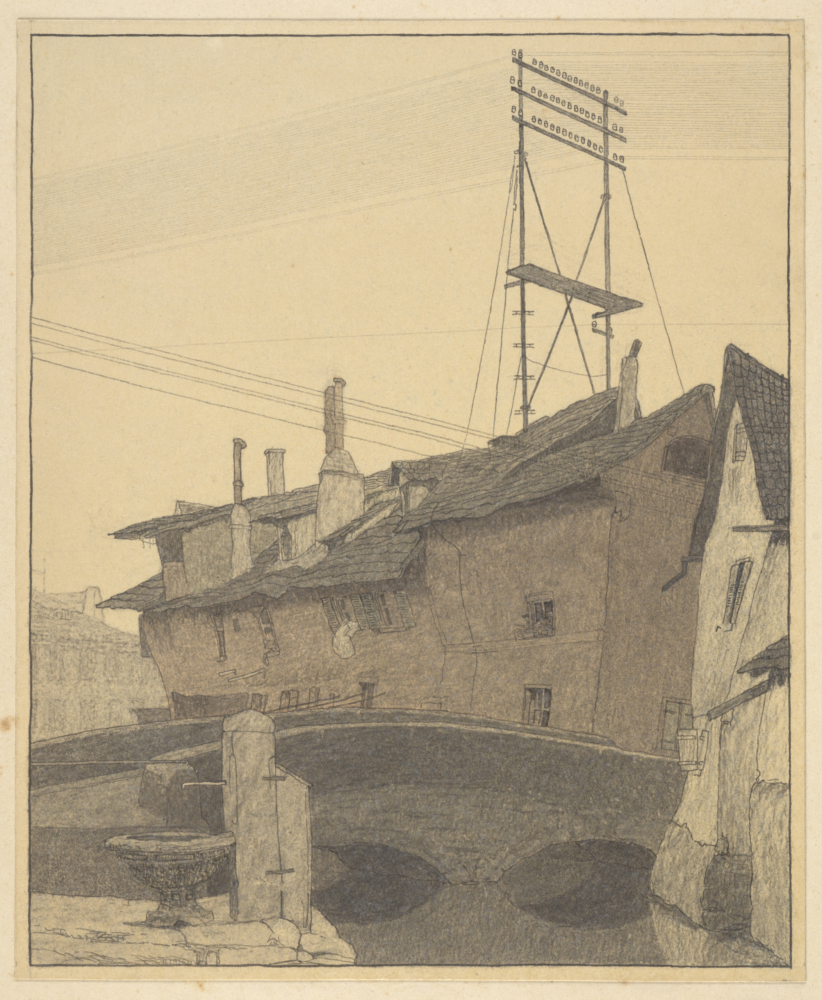
The setting is devoid of people. In the foreground, the delicate spout of a well is set over a stone plinth basin; a little stream, calmly flowing past behind it, reflects the twin-arched bridge. The sky is bright, rendered in the colour of the drawing paper, a light surface over the houses with their stone façades.
Chimneys rise, rather like foreign bodies, from the sloping roofs. The modern cables and wires in the scene seem to run counter to the effect of the crooked houses. Above the dwellings, innumerable telephone lines and a double mast soar upwards, almost as if a spider were weaving a web.
Two worlds collide
This picture can be divided into two parts – the ramshackle houses below and the sky above criss-crossed by modern technologies. In this composition, the houses are shown packed together. One wonders just how much longer the old buildings can withstand the weather. In their extremely fragile state, they seem almost a caricature.
Karl Hubbuch began studying at the Academy of Fine Arts in Karlsruhe in 1908. In his first years, he focused on drawing, depicting villages, life and landscapes in the Kraichgau region. This work – Small Town Houses with a Stone Bridge – dates from this early creative period.
It shows a fictive view, probably inspired by two places in the town of Bruchsal. Here, the Nepomuk Bridge on Klosterstrasse has been combined with the Little Venice district along the Saalbach river – a district later destroyed in the Second World War.
By juxtaposing the old, dilapidated houses and the new technologies, Hubbuch addresses the rapid advances in electrification which, around 1910, had spread to rural areas, permanently changing the realities of life there.