


Looking Down from Above
0:00
0:00
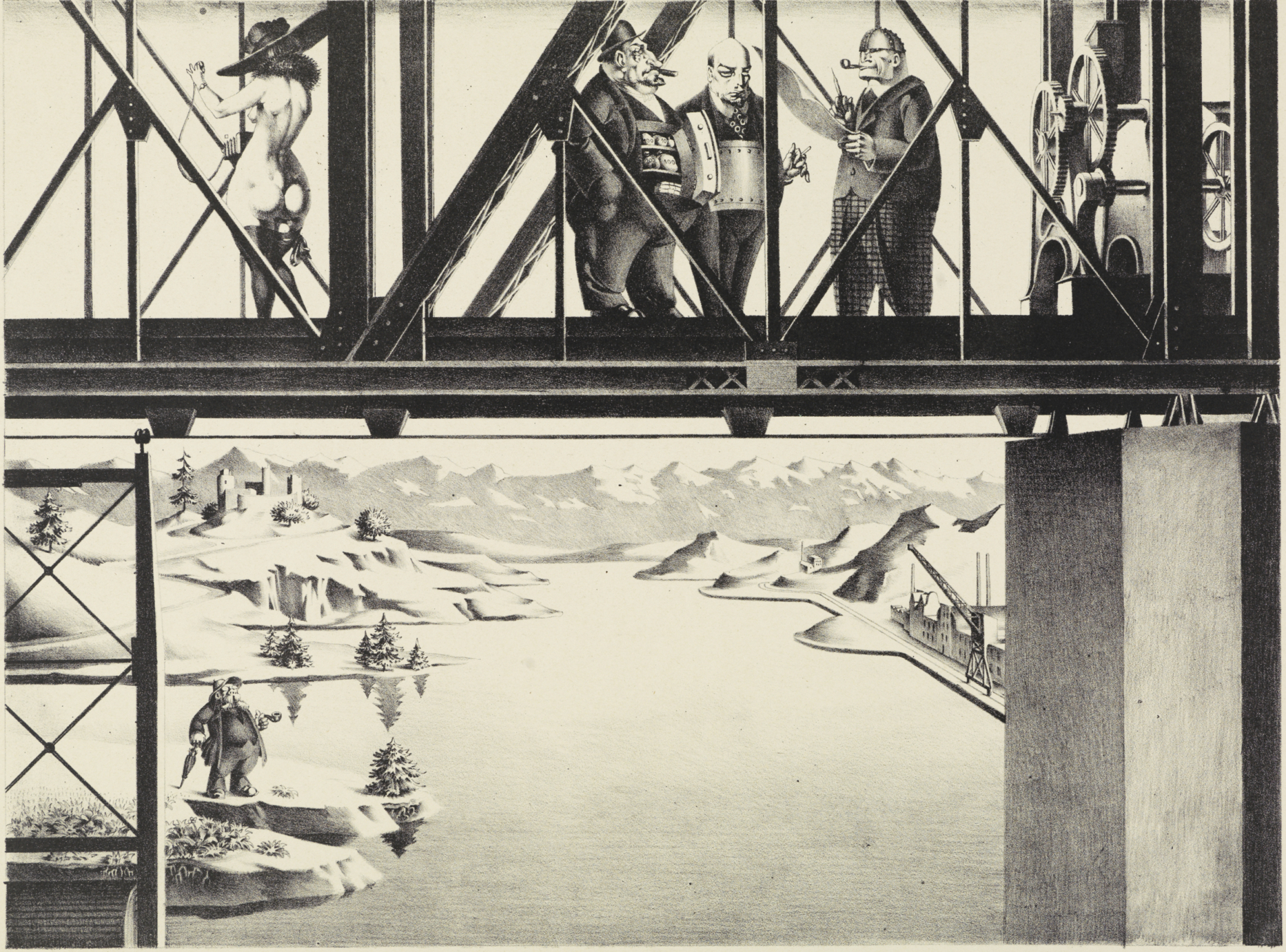
Wow, a very different view of a bridge – and in a closely cropped scene. In this lithograph, Georg Scholz does not depict both ends of the bridge.
Instead, we are looking at and under it, at the top of it and below. The bridge itself comprises an unadorned metal structure resting on a massive concrete pier which looks as if it could be a kind of lock or floodgate.
Criticism of politics and society
Georg Scholz’s lithograph dates from 1922. He is regarded one of the ‘verist’ artists, a socially critical group in an art movement which, from 1924, was dubbed Neue Sachlichkeit – New Objectivity.
This movement reflected the political and social conditions during the years of Germany’s Weimar Republic. The works of many New Objectivity artists address the topics of the aftermath of Germany’s defeat in the First World War and the divided society in the post-1918 years.
The elite in their own circle
Above, we can see a rather bizarre group of people with strange features; below, the view opens onto a spreading landscape with a large body of water, mountains on the horizon, and a castle opposite a factory.
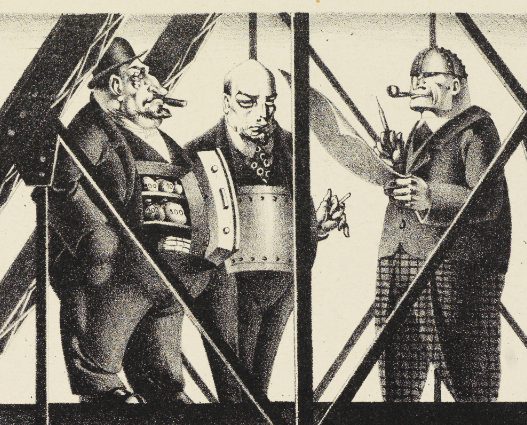
On the bridge, the two stocky men with safes for stomachs form a group with a man with an angular face. He is wearing a helmet and holding a pen and sheet of paper, rather like a newspaper. Facing each other, the men are standing next to a set of cogwheels, most likely part of a machine.
Here, Scholz’s ‘Lords of the World’ are identifiable as specific people – on the left, the steel magnate Hugo Stinnes; in the centre, industrialist and politician Walther Rathenau; and to the right, the US banker Frank A. Vanderlip.
They are the lords over capital, the floodgate, industry and nature. For them, everything has its price – perhaps also the woman set off on the bridge with her back to them. Apart from her stockings, hat and feather boa, she is naked.
The camera she is holding is focused on the area under the bridge. She is just about to take a picture, possibly of the pipe-smoking walker underneath, or a shot of the landscape with the castle – a memento of a piece of nature which is still seemingly intact.