


A View into the Philostratus Room of the Kunsthalle
0:00
0:00
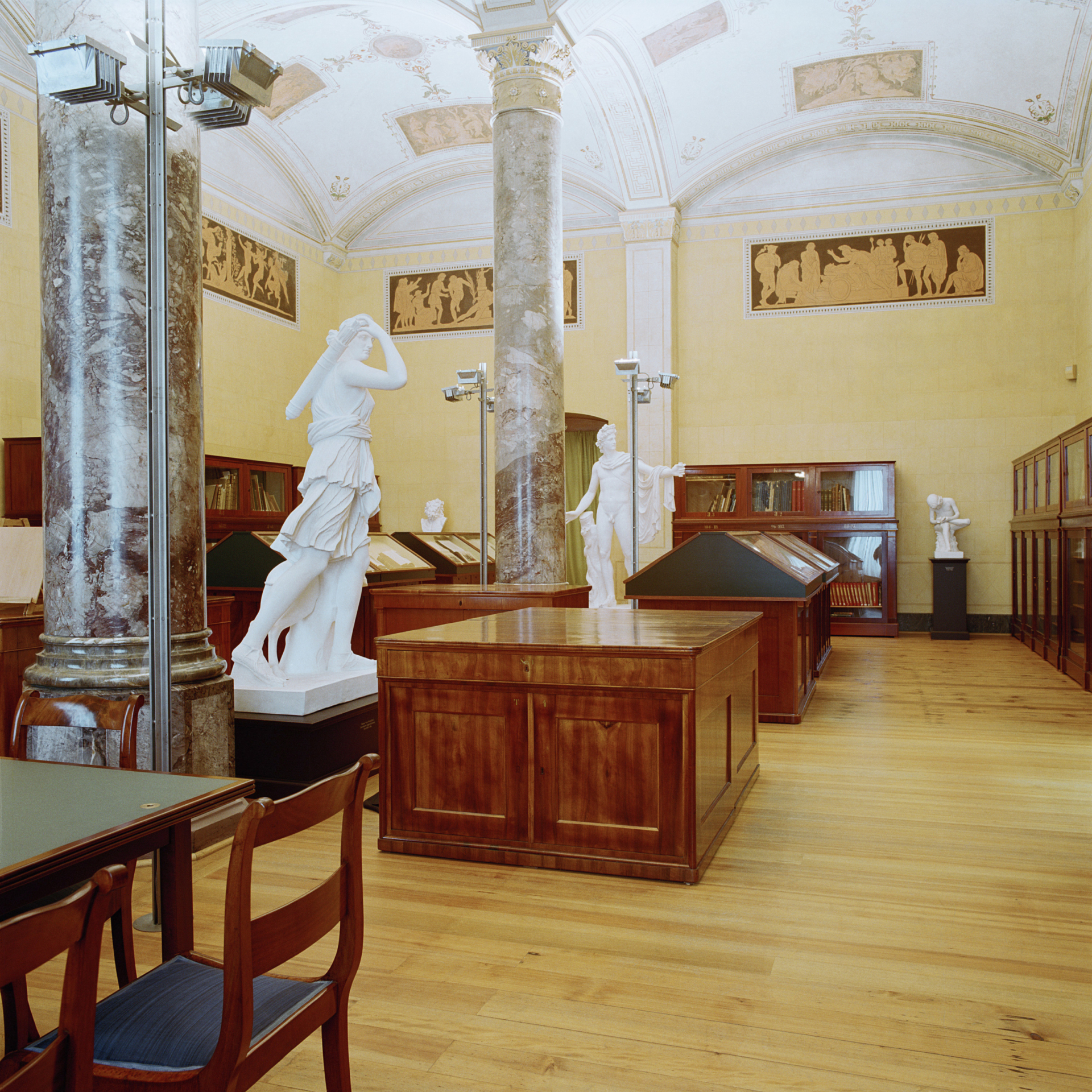
This is one of the rooms in the Staatliche Kunsthalle’s main building, at present closed to the public. We are gazing into the reading or viewing room known as the Philostratensaal – Philostratus Hall. There are rows of historical dark-brown furniture – angled display cases, bookcases, and reading desks – all set on a brown wooden floor which creaks at every step.
To the left, a table and chair are ready for someone to take a seat and study portfolios of prints and etchings. In the middle of the room, the ceiling is supported by two Corinthian columns. Just like the top of the walls, the ceiling too is decorated with frescos. With, as it were, the front façade’s bank of windows behind us, the photo shows us a view towards the room’s entrance door, hung with green material, but here obscured by the rear column.
Before the building was closed, the display cases in the Philostratus Hall showed temporary exhibitions of works on paper. Designed in 1836 by the architect Heinrich Hübsch, this room was originally intended as a space to study antiquity – for practical work within the academic study of art.
German photographer Candida Höfer has dedicated an extensive series to the Kunsthalle’s rooms. She took no less than four photographs just of the Philostratus Hall. All her compositions capture the rooms devoid of people, the mood quiet and contemplative. It is almost as though viewers have the room to themselves, quite undisturbed and without any time pressure at all.
A room full of history and stories
This is a place full of history, with many stories to tell. The Philostraten Hall is named after the Eikones – literally, Images – a work by Philostratus, a Greek sophist from the third century Common Era. The wall and ceiling frescoes, the work of Moritz von Schwind, are based on Greek sagas. In creating his designs from this literary material, von Schwind also drew on Johann Wolfgang von Goethe’s essay Pictures of Philostratus from 1818.
On the wall in front of us, Achilles is shown on the right in tears over the body of Antilochus. The fresco to the left – partly covered by the column – depicts the death of the champion wrestler Arrhichion; and to the far left, at right angles to the other frescos, there is a scene of a Bacchanalian dance.
The subjects are arranged so viewers are taken along a set path. The content is also reflected in the sculptures here too. The four plaster casts of classical sculptures continue the mythological narrative. The Diana of Versailles, as it is known, shows the goddess of the hunt drawing an arrow from her quiver; the statue further behind her is the famous Apollo Belvedere.
In the right-hand corner, the Spinario or Thorn Puller is carefully examining the sole of his foot, while the left-hand corner is decorated by a bust of the Trojan priest Laocoon.
The space itself has a story to tell
The room too has its own story to tell, evident in the empty spaces in some ceiling frescos. War and water damage led to parts of the wall and ceiling breaking off in clumps, damaging the frescos. The decision was then taken to make the loss of these images part of the restoration. So rather than retouching and supplementing the missing parts with figures, for example, those empty surfaces were only painted over in a suitable colour.