


Celebrating the Beauty of the Rounded Arch
0:00
0:00
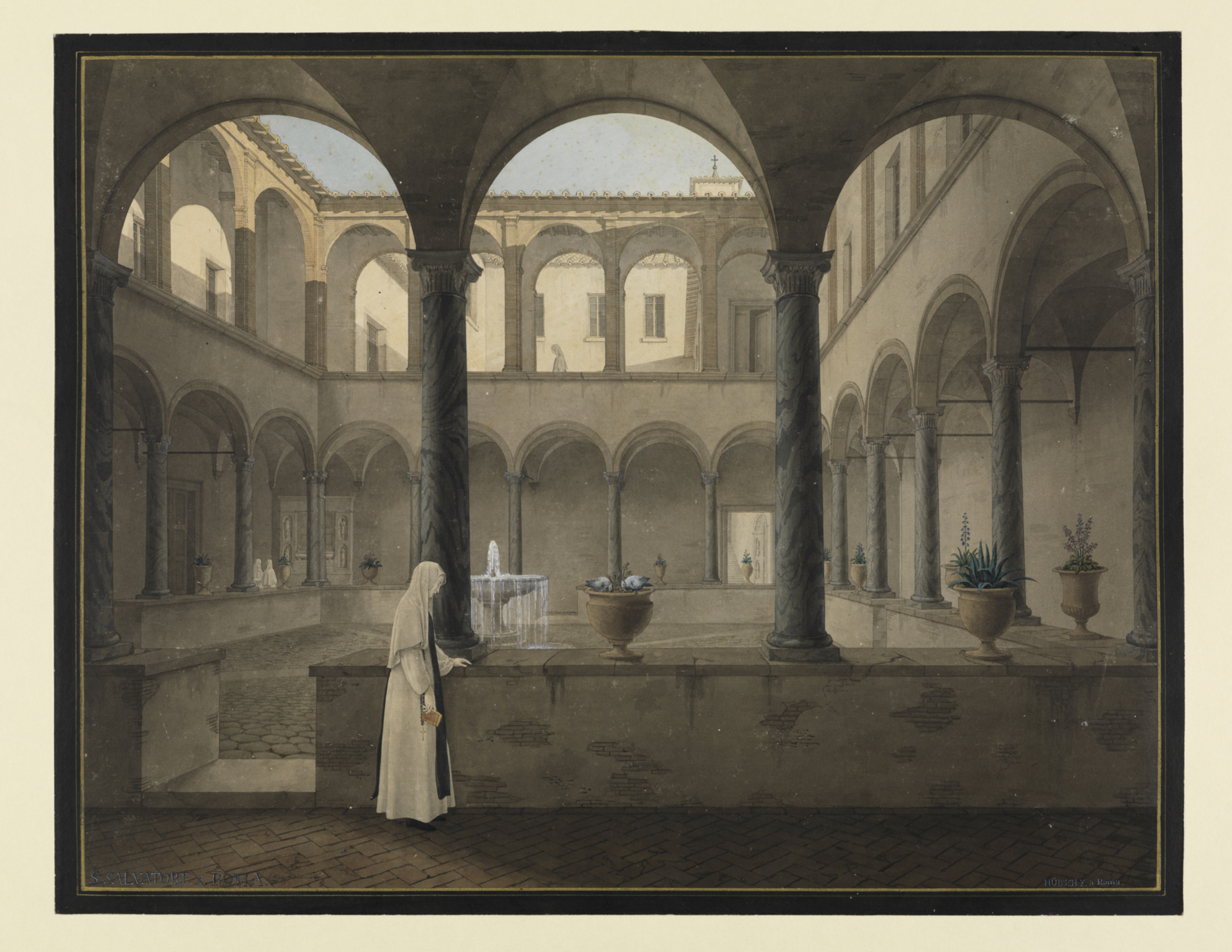
Our gaze is drawn into the scene through three arches of the open arcade in an Italian Renaissance-style two-storey cloister. Round arches everywhere. The elegant arcade columns and their roof vaults support the pillared arcade above. The artist has meticulously rendered the building’s diverse materials, from crumbling walls to marble columns and a variety of paving stones.
In this carefully composed architectural setting, the nuns, deep in thought, are standing singly or in twos. In their white habits, their static figures themselves almost resemble column-like elements. Most likely, the only sounds disrupting the cloister’s meditative silence are the gentle splashing of the fountain and the fluttering pigeons.
The sunlight plays on the rear wall of the courtyard, and the arches on the upper storey open the view to the building behind.
This watercolour was not the work of a trained artist, but the Karlsruhe architect Heinrich Hübsch. Shortly after studying under Friedrich Weinbrenner, he undertook a number of architectural study trips. In Rome, he focused especially on sketching religious buildings and was particularly interested in their architectural features, above all, the Romanesque and Renaissance styles of arches, domes and roof vaults.
Back in Karlsruhe, these studies enabled him to develop a theoretical basis for the Rundbogenstil – the round arch style – an important precursor of 20th-century architecture. He expounded this style in his writings as well as built architectural designs, some which still shape parts of Karlsruhe’s cityscape today.
Heinrich Hübsch’s works include the Orangery, where you are now, the Staatliche Kunsthalle’s main building, and the former Polytechnic, which became the main building of the later university, today’s Karlsruhe Institute of Technology. After the Kunsthalle was constructed, Hübsch was commissioned to restore and rebuild the west façade of the Romanesque cathedral at Speyer.
In that sense, this watercolour is a record of his early affinity to the Rundbogenstil – ‘his personal style’.