


Hustle and Bustle in London
0:00
0:00
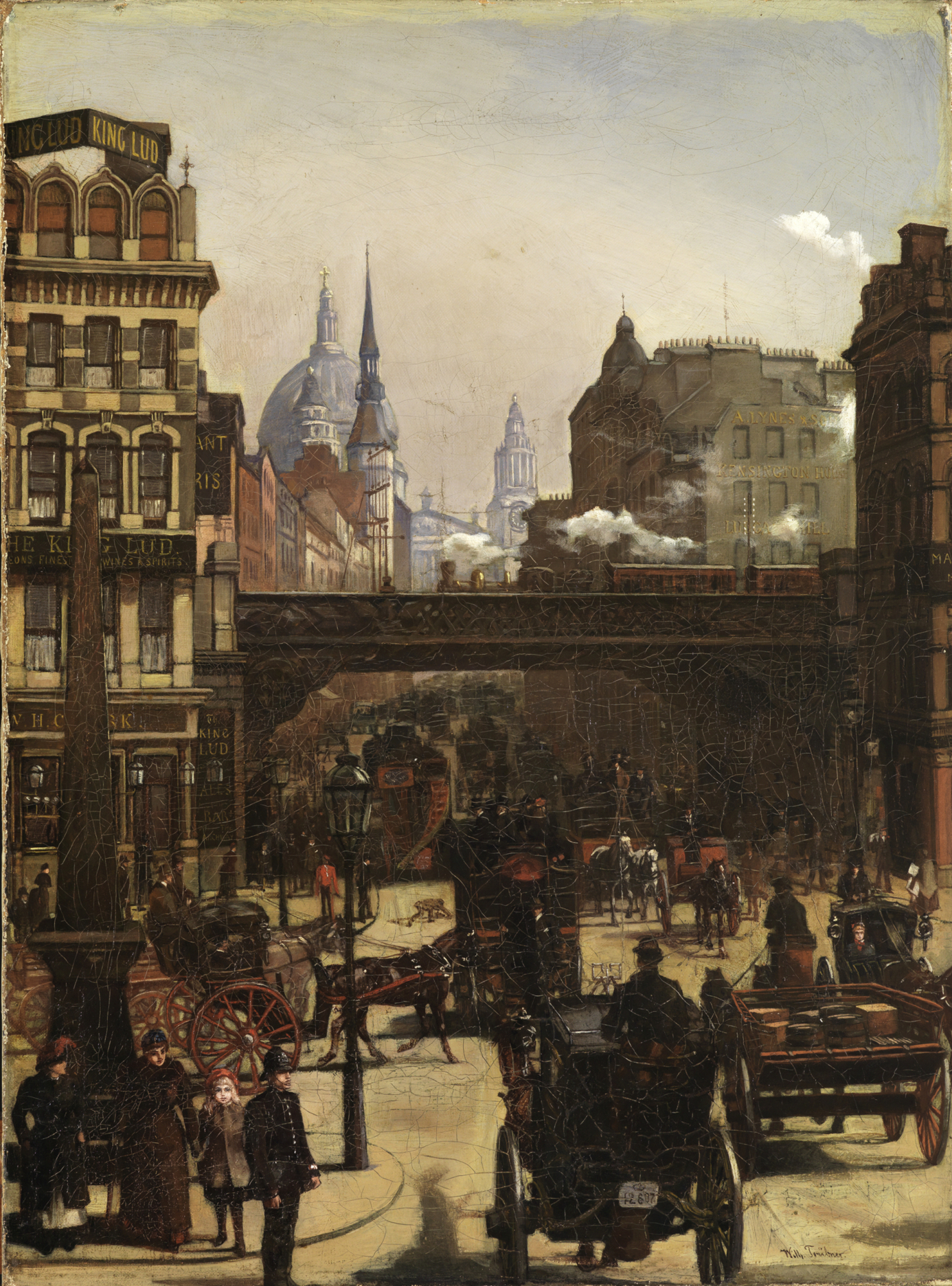
Ludgate Hill, one of London’s three hills, is bustling with activity. To modern eyes, urban traffic in the Victorian age may look chaotic, but also rather picturesque. Along the street lined by towering commercial premises, the horse-drawn delivery carts, hansom cabs and private carriages gradually become lost as they pass into the distance beyond the Ludgate Railway Bridge.
In the middle of this mass of wagons and carriages, a man bends over to collect horse manure – a perilous task. In front of the pavement on the left, a London ‘bobby’, his face completely expressionless, keeps an eye on things so the elegantly dressed pedestrians can cross the road.
Rising up behind them, a dark obelisk commemorates Robert Waithman, once Lord Mayor of London. On the commercial building in the background, the gold letters of adverts glitter in the light.
The dome of St. Paul’s Cathedral, tinted blue in its aerial perspective, stands out in the distance – nearly 200 years older than the railway bridge, so modern at that time. In that sense, this cityscape brings different eras together.
When he painted this work, Wilhelm Trübner was 33 years old and visiting London to stay with his uncle, Johannes Nikolaus Trübner, who ran a publishing house and bookshop – in fact, directly in the building behind the bridge on the right with the smoke from a passing train wafting by.
At that time of his life, Trübner was already a familiar figure in the circles of fellow German expressionists Max Slevogt, Max Liebermann and Lovis Corinth. Yet he opted for a realist picture of the hustle and bustle of the metropolis. Rendered in a darker palette, it has little in common with the treatment of light in urban scenes by contemporary German and, in particular, French artists.
Instead, Trübner emphasises the seriousness of this buzz of activity in the modern English metropolis.