


Van Gogh’s First Commissioned Work
0:00
0:00
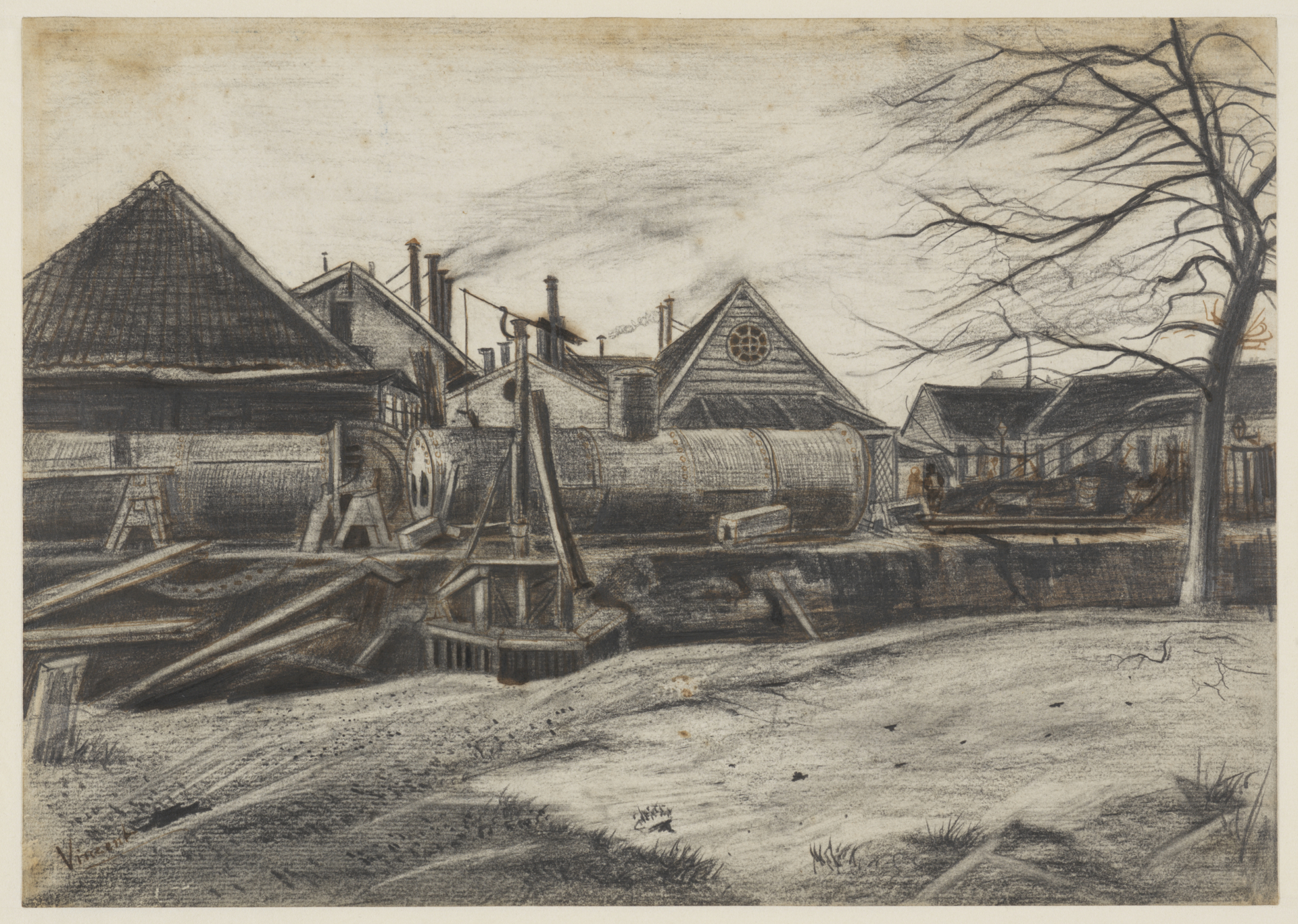
The buildings are hardly welcoming – quite the contrary. We are facing blocked and barricaded walls. Yet something in this forbidding ensemble, with its rail tracks in the foreground and houses and steel objects behind, awoke the interest of the artist.
The iron foundry near Rijnspoor Station
In 1882, during the era of industrialisation, Vincent van Gogh drew the Sterkman Factory, an iron foundry near the Hague. In these years, Holland too needed a vast volume of iron goods to construct buildings, vehicles and transport routes. As small artisan production sites grew into ever larger manufacturing complexes, a factory might look just as grotesque and monstrous as this.
With the large metal objects and the canal in front, it resembles a fortified stronghold. At that time, long hours, short rest breaks, child labour and poor nutrition were common in factories.
None of that is visible in Van Gogh’s sketch, yet in his depiction of the bizarre surrounding he may be alluding to conditions inside the factory.
Here, the human being is merely secondary, a means to an end. At the heart of this seeming disorder, four sketchy figures are just visible on the right of the scene. The foreground conveys the melancholy bleakness of winter. The bare tree offers no comfort, and we sense the chilly wind blowing across the scene.
Gloomy March Mood
In mixed media of black chalk, pencil and ink, Van Gogh creates a desolate, even oppressive atmosphere. With its triangular gables, rectangular locomotive boilers, and rail-like metal objects, the factory scene is dominated by geometric shapes.
Trails of smoke, a sign the factory is operating, drift across an otherwise unstructured sky. The little warmth in the scene comes from a few accents in sepia, a brown-coloured ink.
This drawing was to remain one of Vincent van Gogh’s few works addressing the topic of industrialisation.