23. May 2026 –
16. Aug 2026
Nanne Meyer
Purposeful wandering

Briefly summarized
The exhibition is dedicated to the extensive body of drawings by artist Nanne Meyer (*1953), who was born in Hamburg and now lives and works in Berlin. Under the playfully poetic title Purposeful wandering, her works open up unexpected ways of seeing, losing oneself, and rediscovering within the historic setting of the Karlsruhe Orangerie.
More than 500 works are on display, including numerous new groups of works created especially for Karlsruhe. Visitors to the exhibition will not encounter a linear narrative. Instead, ever-new connections unfold: lines become pathways, stains evoke landscapes, oranges resemble planets or suns. Much appears to be in the process of becoming, while other elements dissolve again. It is precisely here that the distinctive quality of Meyer’s art emerges. For decades, she has been regarded as one of the leading figures in contemporary drawing. Writing and language are essential components of her artistic practice.
Since the late 1970s, the artist has worked almost exclusively on paper. For her, drawing is a form of thinking that always begins with personal perception, with associations playing a central role. She frequently works with found materials such as maps, foxed paper, and misprints from the production of her own publications.


What is usually overlooked or discarded becomes the point of departure for new works. In her practice, graphic precision is combined with an open, often surprising perspective on the world and its existential questions concerning one’s place within it and the search for orientation amid processes of becoming and passing away. Purposeful wandering reflects Nanne Meyer’s artistic method: she is a draughtswoman who uses pencil and brush to open up new possibilities of thought, exposing herself to unfamiliar processes and unpredictable outcomes. Her drawings evolve tentatively, sometimes searchingly. The exhibition invites visitors to move through the spaces without a fixed direction and to discover new ways of seeing.
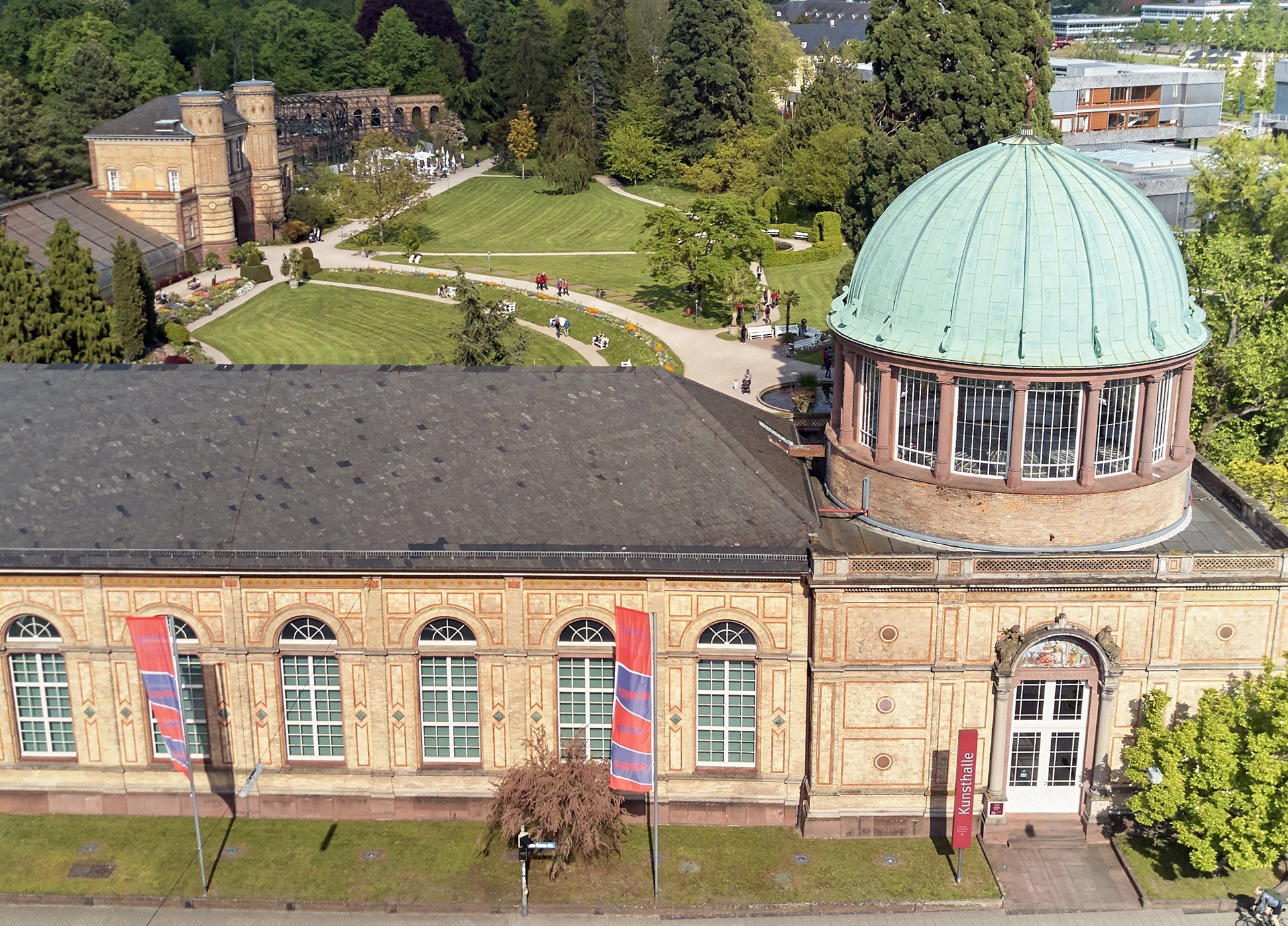
For Karlsruhe, the artist engaged intensively with the historic Orangerie. The building brings together architecture, light, and nature in a particularly striking way. Many of the new works revolve around the motif of the orange — as fruit, color, and visual form. At times oranges appear like small suns or planets; at others, mould-covered fruits evoke strange landscapes or cosmic surfaces. Observation of nature, humour, and poetic imagery intertwine throughout.