


Wellness in a Stunning Atmosphere
0:00
0:00
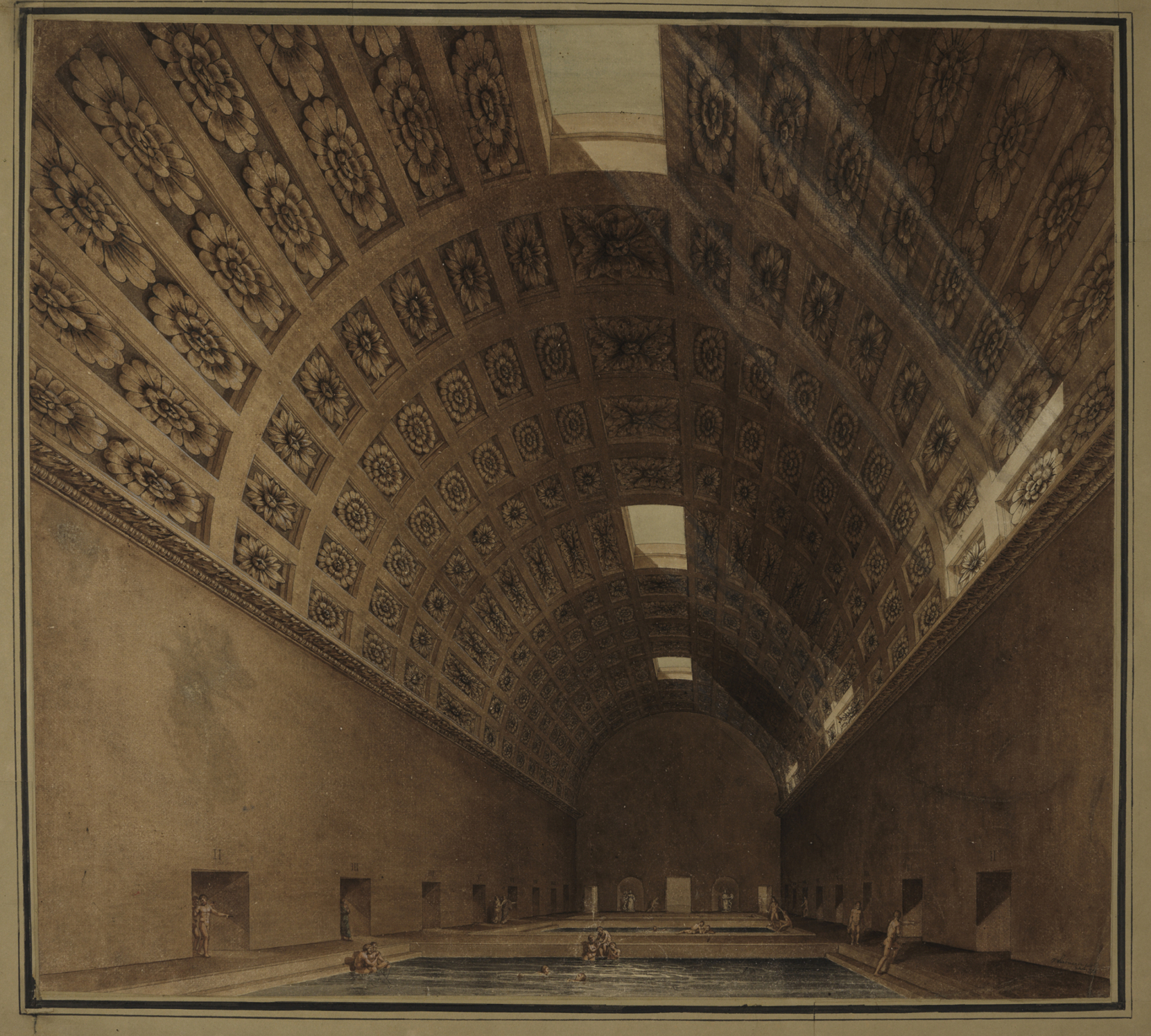
Just imagine you are swimming in this bath house, feeling the water flow over your skin. You look upwards, into the breathtaking heights of the barrel vault. In this work, the artist Friedrich Weinbrenner takes us back into history to imagine the glory of antiquity.
Their legs dangling in the water, people sit on the edge of the pool under the high coffered ceiling. As the sunlight pours into the vault through three openings in the roof, it lights up the rosettes. The scene depicts an ancient bath house exorbitantly praised in the writings of Lucian of Samosata, one of the leading satirists in classical Greece.
Inspired by Lucian’s description, Weinbrenner has composed the bathhouse as he imagines it.
In 1822, Weinbrenner dedicated a treatise on the architecture of antiquity to the Grand Duke of Baden, Ludwig Wilhelm August. In it, he also described this work from 1794, created under the serene skies of Italy while he sought to find the spirit of the ancients in his studies of art. He wrote:
«After studying for some years in Rome, I wished to take on the patriotic task of restoring the so-called old Roman baths found in Badenweiler in my native country in 1784, to transmit, as a sign of my industry and my studies in Rome, something significant from my work to my then living, now deceased sovereign Grand Duke Karl Friedrich.»
In fact, in 1784 Karl Friedrich, Grand Duke of Baden, had begun to uncover, secure and protect the remains of a wall at the Roman bath house in Badenweiler. In Baden, this marked the start of an interest in and commitment to archaeological research driven by science and the ideas of the Enlightenment.
Weinbrenner made the first sketches of the reconstructed Badenweiler thermal baths. However, he only first published them in 1822 when he was Chief Director of the Baden building administration in Karlsruhe.